
Coffee
How Is Instant Coffee Made? From Coffee Beans to Your Coffee Cup
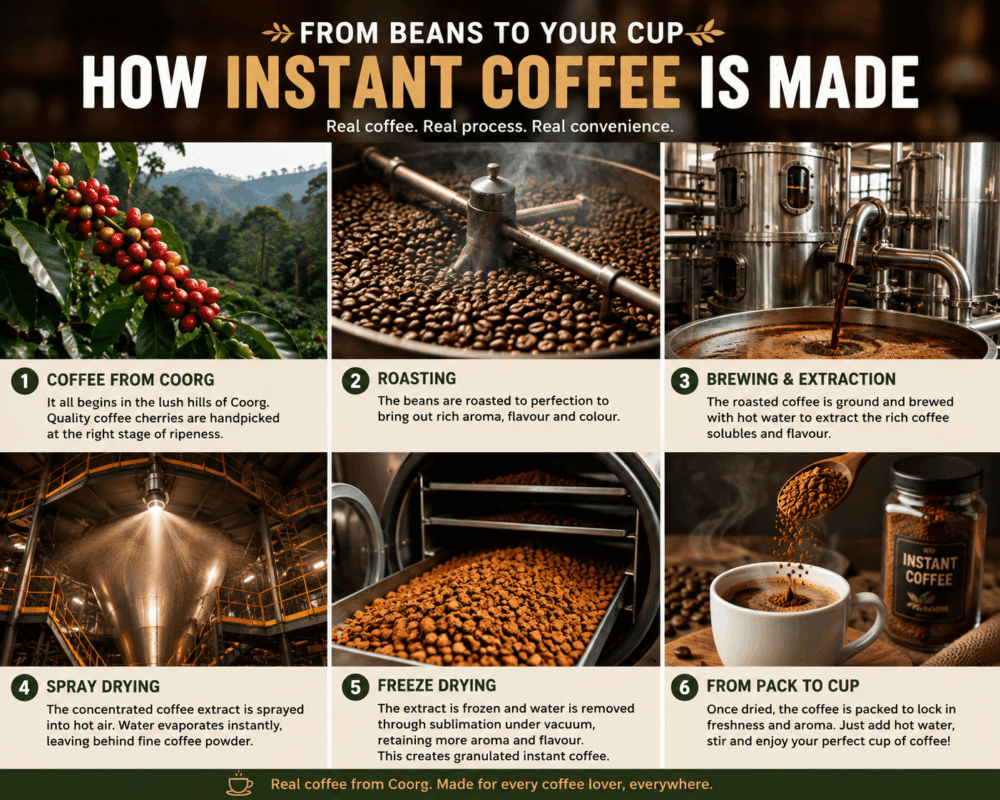
Have you ever wondered how a cup of instant coffee can be prepared in just a few seconds?
You simply add a spoonful of instant coffee to a cup, pour in hot water, stir—and your coffee is ready.
But instant coffee doesn’t start as a powder.
It starts with real coffee beans.
The beans are roasted, ground, brewed into a concentrated coffee extract, and then carefully dried to remove the water. The result is the familiar instant coffee powder or granules that dissolve quickly when you add hot water.
In this article, let’s take a closer look at how instant coffee is made, the difference between spray-dried and freeze-dried coffee, and why instant coffee tastes different from freshly brewed coffee.
What Is Instant Coffee?
Instant coffee is essentially brewed coffee with the water removed.
Instead of grinding coffee beans and brewing a fresh cup every time, manufacturers brew coffee on a much larger scale and then remove the water from the coffee extract.
When you add hot water to instant coffee, the dried coffee solids dissolve again, giving you a ready-to-drink coffee.
So, despite its convenience, instant coffee begins with the same basic ingredient:
Coffee beans.
How Is Instant Coffee Made?
The production of instant coffee generally involves several major steps:
Coffee beans → Roasting → Grinding → Brewing → Concentration → Drying → Packaging
Let’s look at each stage.
1. Coffee Beans Are Selected
The process begins with green coffee beans.
Depending on the product, manufacturers may use different coffee varieties and blends to achieve a particular taste, aroma, strength and price.
The quality of the beans has a major influence on the final coffee.
For coffee-producing regions such as Coorg (Kodagu), the growing conditions, altitude, rainfall and processing methods can all contribute to the characteristics of the coffee.
2. The Coffee Beans Are Roasted
Green coffee beans don’t have the familiar brown colour or roasted coffee aroma that we associate with coffee.
That changes during roasting.
The beans are heated to high temperatures, causing complex chemical reactions that develop:
- Coffee aroma
- Colour
- Flavour
- Bitterness
- Roasted notes
The roasting level can significantly affect the final taste of the coffee.
Light, medium and dark roasts can produce very different flavour profiles.
3. The Roasted Beans Are Ground
After roasting, the beans are ground.
However, the purpose of grinding at an instant coffee factory is different from simply preparing coffee at home.
The ground coffee is prepared in a way that allows manufacturers to efficiently extract the desirable soluble coffee compounds during the industrial brewing process.
4. The Coffee Is Brewed
This is one of the most important steps.
The ground coffee is mixed with hot water in large industrial brewing systems.
The process extracts soluble compounds from the coffee grounds and produces a strong coffee extract.
Think of it as making an extremely concentrated version of coffee.
The goal is to extract the coffee’s desirable flavour and aroma compounds while leaving the insoluble coffee grounds behind.
5. The Coffee Extract Is Concentrated
The freshly brewed coffee extract contains a large amount of water.
Before it can be converted into instant coffee, some of this water needs to be removed.
Manufacturers commonly use concentration techniques such as evaporation under controlled conditions.
Reducing the amount of water makes the next drying stage more efficient.
The result is a thick, concentrated coffee extract.
6. The Coffee Is Dried
Now comes the step that turns liquid coffee into instant coffee.
There are two major methods used:
Spray Drying
In spray drying, concentrated coffee extract is sprayed into a stream of hot air.
The tiny droplets have a very large surface area, allowing the water to evaporate rapidly.
The remaining coffee solids form a dry powder.
This method is:
- Fast
- Efficient
- Suitable for large-scale production
- Generally more economical
Spray-dried coffee usually has a fine powder-like appearance.
Freeze Drying
Freeze drying works differently.
The concentrated coffee extract is first frozen.
The frozen coffee is then placed under vacuum conditions.
Instead of melting into liquid water, the ice is removed through sublimation, where solid ice changes directly into water vapour.
This leaves behind porous coffee granules.
Freeze drying can help retain more of the coffee’s original aroma and flavour characteristics.
Freeze-dried coffee therefore often has larger, irregular-looking granules compared with spray-dried coffee.
Spray-Dried vs Freeze-Dried Coffee
| Feature | Spray-Dried Coffee | Freeze-Dried Coffee |
|---|---|---|
| Process | Hot-air drying | Freezing + vacuum drying |
| Appearance | Fine powder | Larger granules |
| Production | Faster | More time-consuming |
| Cost | Generally lower | Generally higher |
| Aroma retention | Good | Generally better |
| Common positioning | Everyday instant coffee | Premium instant coffee |
Both methods can produce good instant coffee. The final quality also depends on the coffee beans, roasting, extraction, formulation and packaging.
7. Aroma Recovery
One challenge in making instant coffee is preserving the aromas created during roasting and brewing.
Some volatile aroma compounds can be lost during processing.
Modern coffee manufacturing therefore uses techniques to capture and recover coffee aromas during processing and reintroduce them into the finished product.
This is one reason why the manufacturing process is much more sophisticated than simply “drying coffee.”
8. The Coffee Is Packaged
Once the coffee has been dried, it needs to be protected from:
- Moisture
- Oxygen
- Heat
- Light
These factors can affect the flavour and aroma of coffee.
The finished instant coffee may be packed in jars, sachets, pouches or other airtight packaging.
Good packaging is important because instant coffee is highly convenient—but it also needs protection from moisture.
Why Does Instant Coffee Dissolve So Quickly?
Instant coffee is made primarily from water-soluble coffee solids.
During manufacturing, coffee is brewed first, meaning the soluble components have already been extracted from the roasted beans.
When the water is removed, those soluble coffee solids remain behind.
When you add hot water again, they dissolve quickly.
That’s why you don’t need a coffee filter or brewing machine.
Is Instant Coffee Made From Real Coffee?
Yes. Instant coffee is made from real coffee beans.
The major difference is the processing method.
Traditional coffee
Coffee beans → Grind → Brew → Drink
Instant coffee
Coffee beans → Roast → Grind → Brew → Concentrate → Dry → Instant coffee → Add water → Drink
In simple terms:
Instant coffee is brewed coffee that has been dehydrated.
Why Does Instant Coffee Taste Different From Freshly Brewed Coffee?
Even though both begin with coffee beans, the processing is different.
During industrial extraction and drying, some aroma compounds can be lost or changed.
Freshly brewed coffee also contains a wider range of volatile compounds that contribute to its aroma and flavour.
The result is that instant coffee can have a different taste and aroma compared with coffee brewed directly from freshly ground beans.
However, improvements in extraction, freeze drying, aroma recovery and packaging have significantly improved the quality of modern instant coffee.
What looks like a simple spoonful of coffee is actually the result of a carefully controlled food-processing process.
Final Thoughts
Instant coffee is more than just coffee powder.
It is the result of taking freshly roasted and brewed coffee and using modern food-processing techniques to remove the water while preserving as much of the coffee’s flavour and aroma as possible.
Whether it is spray-dried or freeze-dried, instant coffee offers one major advantage: convenience.
And the next time you stir a spoonful of instant coffee into hot water, you’ll know exactly what happened before it reached your cup.
From the coffee plantation to your kitchen, every spoonful has a story.
Explore the Taste of Coorg
Coorg’s coffee heritage is closely connected with the region’s plantations, spices and unique agricultural environment.
At CoorgSpices.com, we aim to bring the flavours and products associated with Coorg closer to coffee and spice lovers.
Discover the flavours of Coorg, one cup and one spice at a time.